Shade over the terrace, gone again before the wind picks up
Retractable folding-arm awnings for Kanonberg's terraces and pool decks — cassette-protected and wind-sensor motorised for a ridge position with few windbreaks.
The seasonal argument a fixed roof can't make
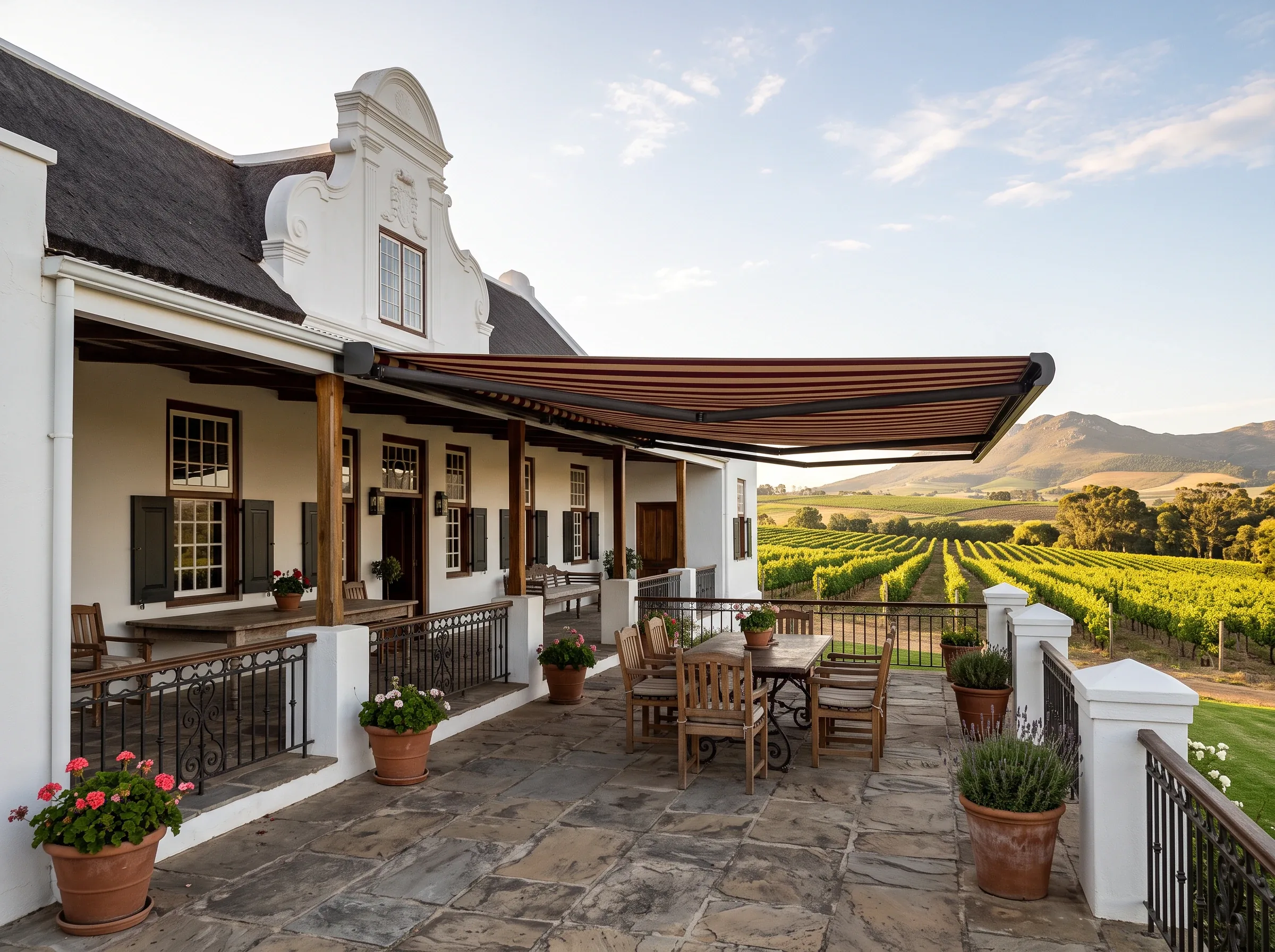
A north- or west-facing terrace on this estate takes hard sun for most of a Cape summer afternoon, which is exactly when a braai deck or a pool terrace needs to stay usable. A folding-arm awning turns that space back into a room worth sitting in — and, unlike a permanent roof, retracts through winter to let the same low sun back onto the terrace when the point is warmth, not shade. No posts means no interrupted vineyard view and no obstacle across the deck.
Why the wind sensor isn't optional here
Kanonberg sits on open ridge ground with far fewer windbreaks than a sheltered, built-up suburb — the Cape Doctor south-easter that blows through most summer afternoons reaches a terrace here with more force than it would a courtyard lower down. An awning caught open in that kind of gust doesn't just flap; it can tear or bend the arms outright. Motorised control paired with a wind sensor is the specification we treat as standard on this site, not an upsell — the awning retracts on its own before the gust arrives, whether or not anyone's home to do it manually.
Cassette or open mount, fabric that holds its colour
A full cassette seals the folded fabric and arms away from weather when retracted — the right call for anything genuinely exposed, which most Kanonberg terraces are. Solution-dyed acrylic fabrics are the standard fit for that exposure: they hold colour under sustained Cape UV rather than fading out within a season or two the way a cheaper printed fabric can. It's a shade product, not a rain product — light drizzle at a pitch is fine, but it's never a substitute for a hard roof in real rain.
On this ridge the awning brief is never just "how big" — it's how fast the motor can get the fabric in once the south-easter starts gusting.
On-site measure, KanonbergWhat an awning costs over a Kanonberg terrace
Awnings are priced per square metre of projection — the terrace actually put in shade when the arms run out — installed. Crank-operated, somewhere in R3,500 to R5,500 for each square metre; an open or semi-cassette in a sheltered spot least, a fully enclosed cassette on an unprotected elevation at the upper. A motor plus wind sensor lifts that to somewhere between R5,500 and R7,500 a square metre.
On a ridge that takes the Cape Doctor square on, the motor and the sensor buy more than extra fabric ever will: an awning that folds itself away as the wind rises is the one still working next summer. A short awning above a door is priced at the minimum, and what the fixings bite into changes shifts the number too. We settle all of that standing at the terrace during the free assessment, and the price you are given afterwards is in writing.
- Projection to roughly 3–4m over terraces and pool decks
- Full cassette protection for genuinely exposed positions
- Motorised as standard, with wind-sensor auto-retract
- Solution-dyed acrylic fabric, colour-fast under sustained UV
- Fixing confirmed on site — stone, render or steel-frame
Got a terrace or pool deck to shade?
We measure at your home for nothing, price every window in writing, and leave the decision entirely with you.